
Your Brain Is Lying to You — And It's Doing You a Favour

Most people who read The Doors of Perception come away thinking it's a book about drugs.
It isn't.
It's a book about how little of reality you're actually seeing — and why that might be exactly what you need.
The reducing valve
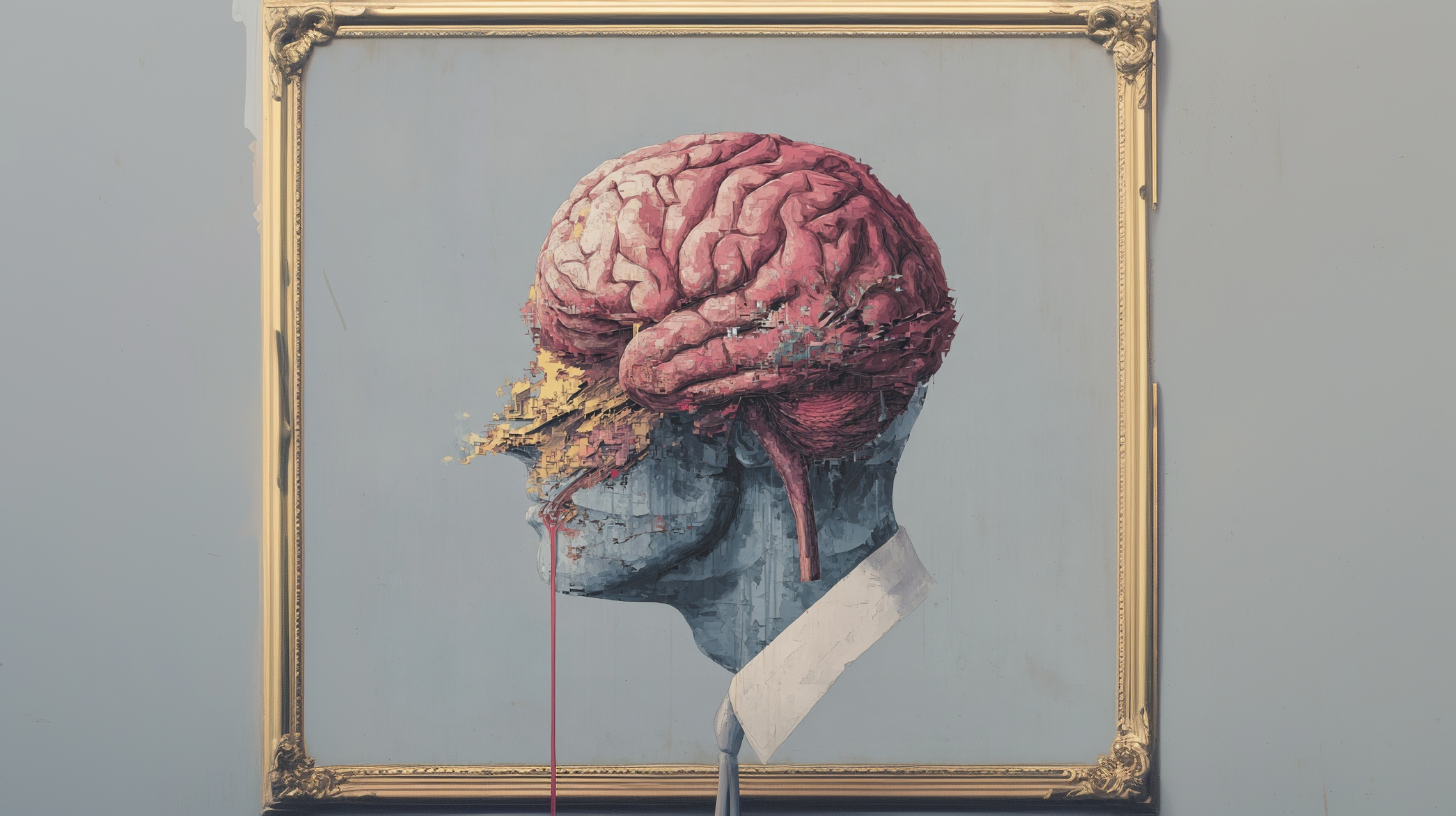
Aldous Huxley's central argument is straightforward and deeply uncomfortable: the brain is not a receiver of reality.
It's a filter.
The amount of information available to your senses at any moment is overwhelming. Light, sound, texture, smell, temperature, movement — all of it happening simultaneously, all of it demanding processing. If you experienced all of it at once, you wouldn't be able to function. You wouldn't be able to act. You'd be paralysed by the sheer volume of what's there.
So the brain cuts most of it out. What remains — what you experience as "reality" — is a heavily reduced version of what's actually present.
Huxley calls this the reducing valve.
The valve isn't a flaw. It's the mechanism that makes survival possible.
You need to see the chair as something to sit on, not as an infinitely complex arrangement of matter radiating light at specific wavelengths.
You need to see the road ahead, not every blade of grass on the verge.
The filter keeps you functional.
But functional and accurate are not the same thing.
What mescaline does
When Huxley took mescaline in 1953, what he experienced wasn't hallucination — it wasn't seeing things that weren't there. It was perception without the usual editing. The filter weakened. More got through.
Ordinary objects became extraordinary. A chair became a thing of pure form and colour, existing in itself, not as a tool. Flowers weren't flowers in the word-and-category sense — they were direct visual experience, overwhelming and precise.
The word "beautiful" felt inadequate because beauty usually implies comparison and judgment, and what he was experiencing was prior to all of that.
He called this "is-ness": objects experienced as what they actually are, rather than what they're useful for.
The shift was from "what is this for?" to "what is this?" — and the answer, stripped of function and label, was almost unbearably vivid.
The problem with language
Part of what makes this experience difficult to describe — and part of what Huxley grapples with throughout the book — is that language is itself a filter.
Words compress experience into symbols. "Flower" is a shortcut. It lets you communicate efficiently, but it strips away almost everything that makes a flower what it actually is. The label replaces the experience. You stop perceiving and start categorising.
This is useful. Without categorisation, nothing gets done. But it means that ordinary language — including the language you use to think about your own life — is at least one step removed from reality. You're not experiencing the world directly. You're experiencing your model of it.
What gets lost when the ego goes quiet
Under mescaline, Huxley noticed something else: the self became quieter.
The constant hum of ambition, anxiety, planning, comparison — all of it receded. There was less sense of being an actor trying to get somewhere, and more of being an observer present to what was already there.
The future and the past became less relevant. The present became everything.
This sounds appealing. And in the moment, it was.
But Huxley was honest about the cost.
This state is not functional.
In expanded perception, you wouldn't build anything. You wouldn't compete, plan, or act strategically. Motivation requires dissatisfaction — a gap between where you are and where you want to be. The reducing valve creates that gap by keeping you focused on goals, not on being. Remove the filter, and the dissatisfaction dissolves, along with everything it drives.
The part most people miss
The popular reading of this book is: expanded perception is better.
More is more.
The filter is the enemy.
That's wrong.
The real argument — the one that takes the whole book seriously — is that your mind lies to you for a reason, and removing that lie has consequences.
Two modes of existence:
Survival mode: filtered perception, goal-driven, useful. You see what you need to see in order to act. This is where most of life happens.
Awareness mode: expanded perception, present-focused, meaningful. You see what's actually there. This is where most people report feeling most alive.
Neither is the whole picture. The person locked permanently in survival mode has efficiency without depth — they've optimised for function and lost contact with the richness of what's actually there. The person dissolved permanently into awareness mode can't do anything with it.
Huxley doesn't give you a prescription. But the implication is clear: the goal isn't to destroy the filter. It's to know it exists.
How this connects to everything else
Read alongside Behave by Robert Sapolsky, the reducing valve stops being philosophical and becomes biological. The brain's filtering of reality isn't a choice or a habit — it's hardwired. Evolution selected for organisms that saw what was useful for survival, not for organisms that saw everything. The filter is ancient and it runs deep.
Read alongside The Elephant in the Brain by Simler and Hanson, the picture gets darker. It's not just reality you're filtering. It's your own motives. The reducing valve doesn't just cut out irrelevant sensory data — it cuts out inconvenient truths about why you're doing what you're doing. You're blind to the world, and you're blind to yourself.
Read alongside Peterson's lectures on personality, the filter becomes a narrative. You don't just see what's useful — you see what fits the story you're already telling about where you're going. Perception is goal-dependent. The gorilla walks through the frame and you don't see it, because you're counting basketball passes.
Three sources, three disciplines, one conclusion: what you experience as reality is a construction. A useful one. A necessary one. But a construction.
What to do with this
Knowing the filter exists changes your relationship to it.
You can't remove it — nor would you want to. But you can build in moments of questioning what you're not seeing. In a business decision, what are you filtering out because it doesn't fit your goal? In a conversation, what is the other person experiencing that your model of them can't accommodate? In your own behaviour, what are you not seeing about why you're actually doing what you're doing?
The filter serves you. But it also deceives you. And the first step to working with it, rather than being run by it entirely, is knowing it's there.
That's what this short, strange, brilliant book actually teaches.
This post contains affiliate links. If you buy through them I may earn a small commission, at no cost to you.