
You Are Not Who You Think You Are

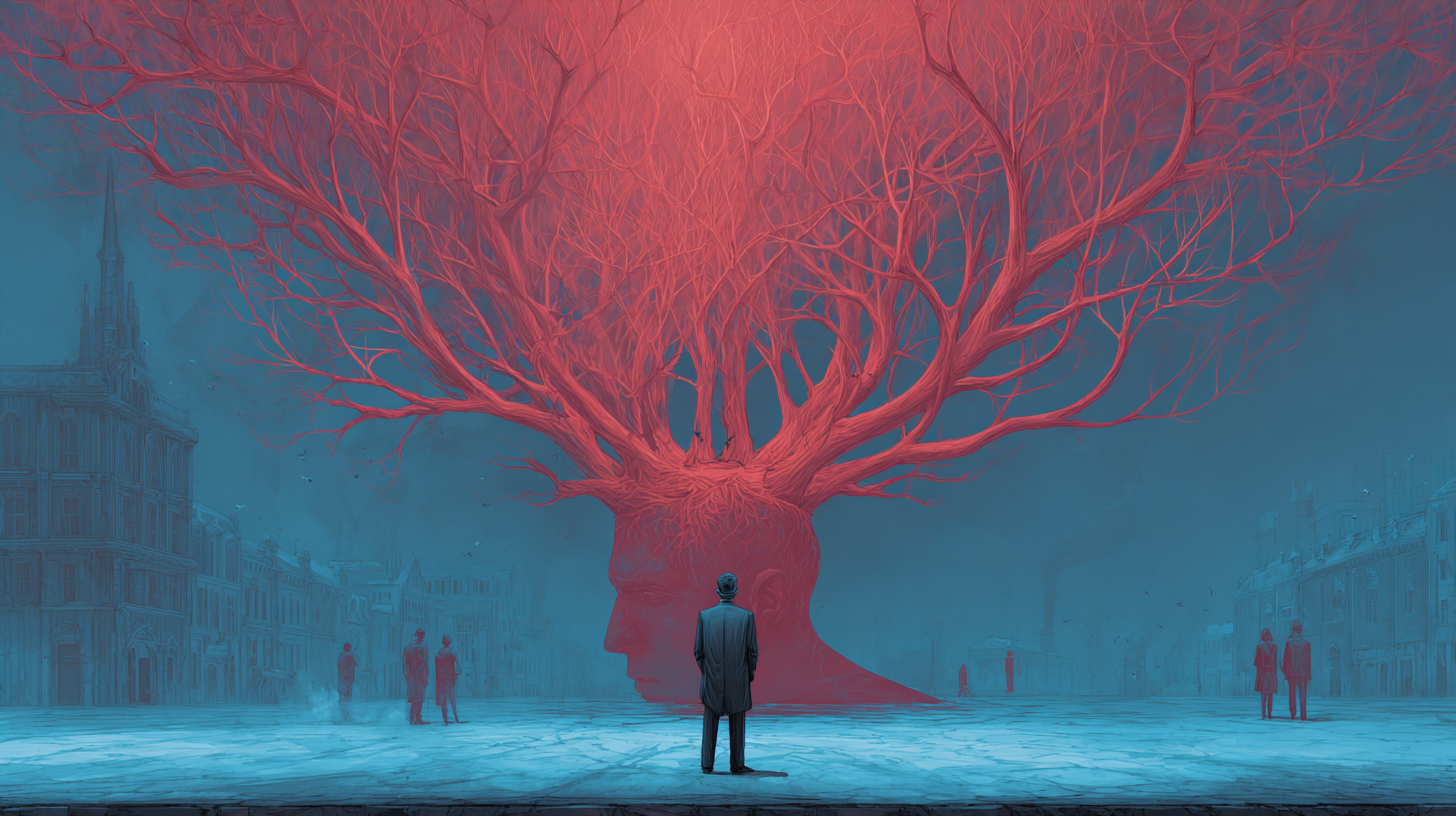
Most people assume they know why they do things.
They're wrong — and the evidence is now substantial enough that ignoring it is a choice, not an oversight.
I've spent the last year working through some of the most rigorous thinking on human behaviour: Sapolsky's Behave, Simler and Hanson's The Elephant in the Brain, Kahneman's Thinking, Fast and Slow, Huxley's The Doors of Perception, and Peterson's lectures on personality. They come from different disciplines — neuroscience, evolutionary biology, economics, philosophy, psychology. But they keep arriving at the same uncomfortable place.
The self you experience as the author of your actions is largely a story told after the fact.
The brain decides before you do
Kahneman splits cognition into two systems. System 1 is fast, automatic, and runs almost everything. System 2 is slow, deliberate, and likes to believe it's in charge. The problem is that System 2 is mostly a commentator — it narrates decisions that have already been made and calls that narration "reasoning."
Sapolsky goes deeper. By the time you make a decision, it has already been shaped by your hormone levels that morning, whether you slept, what your cortisol did when something stressed you an hour ago, and neural patterns laid down in childhood. The neuroscience is unambiguous: the conscious experience of choosing arrives after the biological process has already begun.
Huxley approached the same wall from a different direction. In The Doors of Perception he documented what happened when mescaline temporarily reduced the brain's filtering function. What he found wasn't hallucination — it was perception without the usual editing. The ordinary brain, he concluded, is not a receiver of reality. It's a reducing valve. You don't see what's there. You see what your brain has decided is relevant to your survival and your goals.
Peterson makes the same point without the mescaline: you don't see what's irrelevant to your current motivational state. The invisible gorilla experiment demonstrates this cleanly. People watching a video and counting basketball passes fail to notice a man in a gorilla suit walking through the frame. It's not that they're stupid. It's that the gorilla wasn't part of their goal, so their brain filtered it out. Perception is not passive reception. It's active construction.
The motives you can see aren't the real ones
Simler and Hanson make the argument most people find hardest to accept: the reasons you give for your behaviour are not the actual reasons. The brain generates post-hoc justifications for decisions that were driven by social signalling, status-seeking, and self-interest — and then presents those justifications to you as if they were the origin.
You give to charity because it makes you look good, not because effective altruism did the calculation. You hold your political opinions because they function as team jerseys, not because you reasoned your way to them. You go to the doctor partly to be seen as someone who takes health seriously. None of this is cynicism. It's evolutionary logic. These were adaptive strategies. But confusing the signal for the motive is where self-knowledge breaks down.
The brain, as they put it, is a lawyer — not a scientist. A scientist starts with evidence and reaches a conclusion. A lawyer starts with a conclusion and finds evidence. Most of what feels like reasoning is the second one.
Stress makes it worse
Sapolsky identifies three conditions that make stress genuinely harmful: lack of control, unpredictability, and no outlet for the resulting frustration. Under those conditions, the amygdala — the brain's threat-detection system — begins to suppress the prefrontal cortex. The PFC is where long-term thinking, impulse control, and considered judgment live. When it goes offline, you're running on older, faster, less accurate systems.
This matters practically. Most bad decisions — in business, relationships, finances — are made under exactly these conditions. The person making the decision believes they're reasoning. They're not. They're reacting from a neurological state that was designed for predator avoidance, not contract negotiation.
So what do you do with this?
Peterson's answer, across seven lectures on personality, is integration. The goal is not to eliminate the automatic, unconscious, biological layers — that's not possible. The goal is to become aware of them so they don't run you without your knowledge.
Truthful dialogue is part of the mechanism. When you articulate something accurately — when you find the right words for what's actually happening — you change your relationship to it. The act of honest expression is not just communication. It's a form of self-ordering. Logos, in the ancient sense: the word that structures reality.
Huxley's conclusion runs parallel. The doors of perception, when cleaned, don't reveal chaos — they reveal more. The reducing valve serves a function. But knowing it's there changes how you use it.
Kahneman's practical contribution is the simplest: slow down before decisions that matter. System 2 is slow by design. The conditions for good judgment are not urgency and stress — they're the opposite. Build in the pause. Question the first answer. Notice when you're rationalising versus reasoning.
The honest version of self-improvement
Most self-help ignores all of this. It treats the self as a rational agent that just needs better habits and stronger motivation. The actual picture is more complicated and, in some ways, more interesting.
You are a biological creature running ancient software in a modern environment. Your perception is filtered. Your motives are partially hidden from yourself. Your reasoning is often post-hoc. You make worse decisions when stressed, tired, or threatened. Your personality contains sub-systems that can take over under the right conditions — anger, fear, desire — each with its own agenda.
Knowing this doesn't make you cynical. It makes you realistic. And realistic is a much better starting point than the flattering story most people tell about themselves.
The work is not to transcend your nature. It's to understand it well enough that it stops operating entirely outside your awareness.
That's a different project. It's slower, less glamorous, and more honest.
It's also the only one worth doing.
This post contains affiliate links. If you buy through them I may earn a small commission, at no cost to you.