


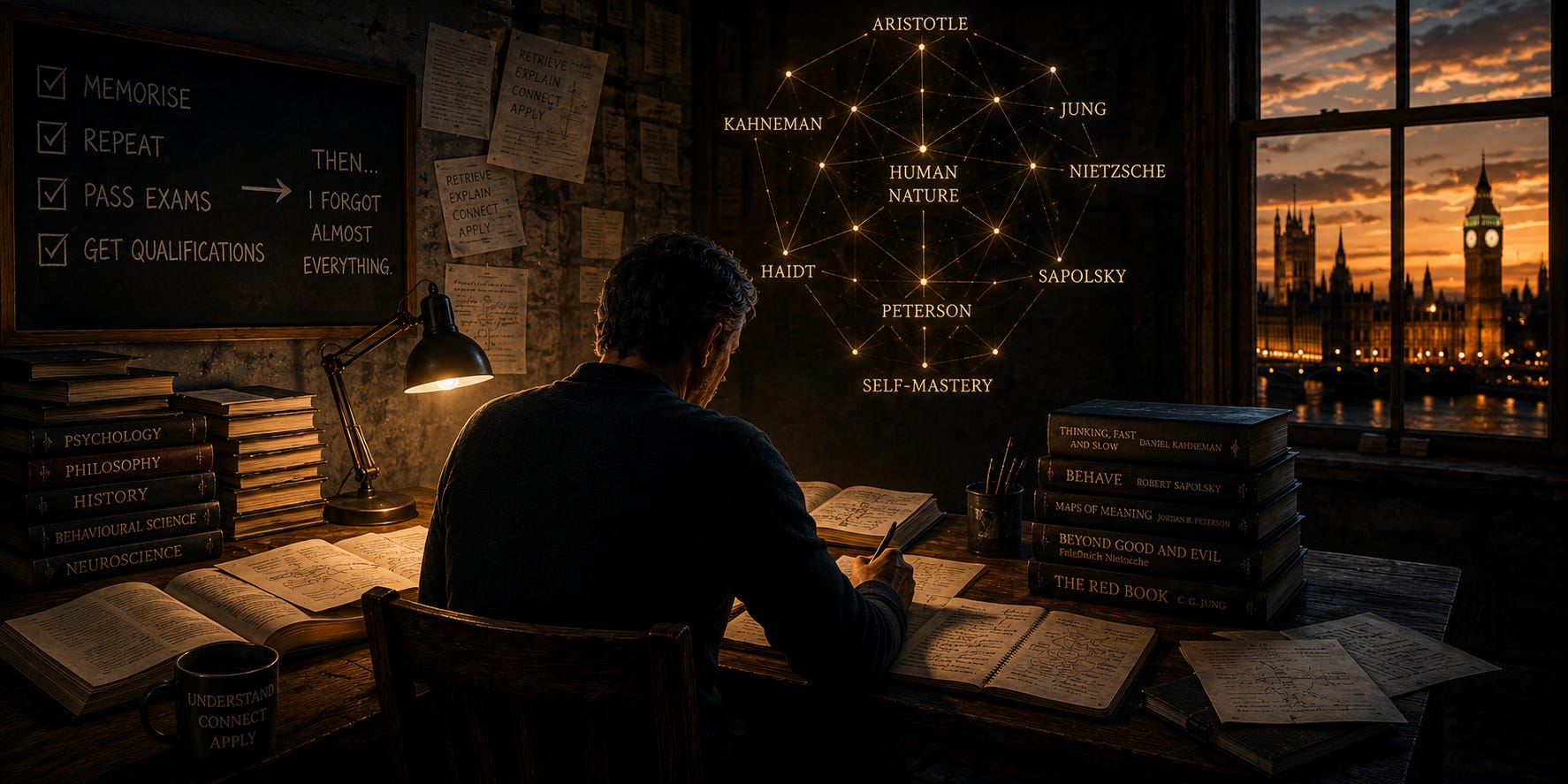
I memorised what I needed, passed the exams and earned the qualifications.
Then I forgot almost everything.
Not just the dates, names and technical details.
Much of the substance disappeared too.
I had completed the education, but the education had not become part of me.
Years later, when I began reading seriously as an adult, I noticed the same thing happening again.
I would finish a book, feel that I had understood it and move on to the next one.
A few months later, I could remember the general subject but struggled to reconstruct the argument. I recognised ideas when I saw them, but could not summon them when I needed them.
The books were passing through me without substantially changing me.
Information is not the same as education
We live in a time of almost unlimited intellectual access.
Books, lectures, podcasts and courses are everywhere.
A person can spend several hours every day consuming serious material and still find that very little of it becomes available when speaking, writing or making decisions.
The problem is not necessarily intelligence or effort.
Consumption creates familiarity. It can produce the feeling that we know something because we recognise it when someone else explains it.
But recognition is not understanding.
Understanding becomes visible when you can retrieve an idea without assistance, explain it in your own words, connect it to other ideas and apply it to a situation that was not included in the original material.
That requires a different kind of learning.
There is a deeper problem
I initially believed that my problem was retention.
I needed better notes, more effective review and a system for connecting ideas across books and lectures.
Those things mattered.
But beneath the question of how to learn was a more difficult question:
What am I learning for?
It is possible to become extremely efficient at travelling in no particular direction.
Many adults accumulate disconnected interests.
We read whatever catches our attention, follow recommendations, save hundreds of articles and begin courses we never complete.
The individual pieces may be valuable, but they do not form an education because nothing organises them.
A real education needs a central question.
What are you trying to understand?
What has repeatedly drawn your attention?
What bothers you that other people seem able to ignore?
What kind of person are you trying to become?
What would you deeply regret never pursuing?
You may not be able to answer those questions immediately. I am not convinced that anyone can determine another person’s “calling” in a single conversation or questionnaire.
But we can develop a provisional answer, and then test it through attention, study and action.
The project I am undertaking
In my late forties, I am deliberately rebuilding my education around psychology, philosophy, human behaviour and self-mastery.
I am studying thinkers such as Aristotle, Jung, Nietzsche, Daniel Kahneman, Jonathan Haidt, Robert Sapolsky, Jordan Peterson and others.
But the purpose is not to accumulate impressive names or repeat their conclusions.
I want to understand the ideas well enough to:
* Explain them without hiding behind quotations
* Compare thinkers who disagree
Recognise the ideas operating in ordinary life
Test them against my own experience
Form conclusions that are genuinely mine
Speak about difficult subjects with confidence and precision
Turn knowledge into better judgement and behaviour
That means:
Reading more slowly.
Retrieving ideas from memory.
Writing about them.
Explaining them aloud.
Connecting each new subject to what I have studied before.
Noticing where my understanding fails and returning to the material.
The objective is not to finish the largest number of books.
It is to become a person for whom the important ones have become part of his thinking.
What I am discovering
Even at this early stage, the effect is different from ordinary consumption.
Ideas begin appearing in conversation without being forced. Connections form between subjects that previously seemed separate.
I would not have seen that reading them one at a time and moving on.
New material becomes easier to understand because there is already a structure to attach it to.
Most importantly, knowledge begins to produce a different kind of confidence.
Not the confidence of believing that you know everything. Serious learning usually reveals how much you do not know.
It is the confidence of having something substantial to contribute. You can stay with a difficult question, examine it from more than one side and explain why you think what you think.
That is a very different outcome from merely finishing a course.
Who this work is for
This account is for:
People who sense that they are capable of more but feel intellectually scattered or undirected.
People who read but remember too little.
People who have consumed years of podcasts, videos and books without building a coherent body of knowledge.
People who want to become more articulate, not to sound impressive, but because clear speech grows from clear thought.
People who suspect that education should change who they are, not simply fill more storage.
And particularly for adults who believe they started too late.
I do not think we started too late.
We may simply have reached the point at which we can finally choose our education for ourselves.
Where this is going
I am documenting the process publicly.
I will share what I learn from psychology, philosophy and behavioural science, but I will also show how I am trying to make that knowledge usable.
That includes:
* The ideas that survive serious examination. I read Dawkins and then the book written to refute him, and wrote about where each one fails
Connections between different thinkers
Practical applications in ordinary life
Methods for remembering and articulating what we learn
Mistakes in my own learning system
The deeper question of how a person finds a direction worth pursuing
Over time, I want to develop a practical way of helping other adults do the same: identify a serious question around which to organise their learning, build a personal curriculum and integrate that knowledge until it changes what they can think, say and do.
I am not writing as someone who has completed that journey.
I am writing as the first participant in it.
The system is being built through use. The ideas are being tested in public.
Every book, lecture, essay and conversation contributes another piece.
The aim is not to know a little about everything.
It is to stop drifting through information and begin building an education deliberately.
To find a direction worth pursuing.
To develop knowledge that becomes part of you.
And, through that process, to become more of the person you are capable of being.
I build a study pack for every book I read. One is free and complete so you can see the standard, and the rest, plus what is coming next, are here.
The reading and the arguments are mine. I write here to find out whether I have understood what I read, because explaining something is the cheapest way to discover whether you actually understood it or only recognised it.
AI is the other half of that. I argue with it, it pushes back, and what you are reading is what survived. English is not my first language, so it also helps me produce the clean version which you read.
Nothing goes out that I could not defend if you asked.
I recently learned in order to really know and understand something you must learn about it, do it, and then teach it.
You're actually describing the difference between information passing through a system and a system reorganizing itself to integrate the pattern. I think it's the retrieval that changes the structure. When an idea has to be used, tested, connected, and applied, the system has to reconfigure to remain coherent. That’s why direction matters: it gives the structure something to organize around so the learning can actually become part of the person. And that is the education every human should have!